Released in 2024, the EJNYC Report is an assessment of historical and present environmental justice issues in New York City. Its findings serve as the foundation for the development of the EJNYC Plan.

The term “environmental justice” means the fair treatment and meaningful involvement of all persons, regardless of race, color, national origin or income, with respect to the development, implementation and enforcement of environmental laws, regulations, policies and activities and with respect to the distribution of environmental benefits. Fair treatment means that no group of people, including a racial, ethnic or socioeconomic group, should (i) bear a disproportionate share of the negative environmental consequences resulting from industrial, municipal and commercial operations or the execution of federal, state or local programs and policies or (ii) receive an inequitably low share of environmental benefits.
The draft EJNYC Plan is organized around three goals:
Goal 1

in EJ Communities (Distributional Equity)
Action Area 1.1
Address disparities in climate hazards and pollutants—in our homes and neighborhoods
Action Area 1.2
Close the gap in food access and green space, starting with those with the least access

Action Area 1.3
Prioritize EJ communities in the renewable energy transition, from streets to harbors
No action areas yet.
Goal 2

EJ into City Systems and Processes (Structural Equity)
Action Area 2.1
Identify and prioritize projects that advance environmental justice

Action Area 2.2
Deliver EJ projects quicker and smarter

No action areas yet.
Goal 3

EJ Communities Meaningfully and Transparently (Procedural Equity)
Action Area 3.1
Improve access to information and data transparency

Action Area 3.2
Collaborate with EJ communities in decision-making

No action areas yet.
Goal 1
in EJ Communities (Distributional Equity)
Action Area 1.1
Address disparities in climate hazards and pollutants—in our homes and neighborhoods
Action Area 1.2
Close the gap in food access and green space, starting with those with the least access
Action Area 1.3
Prioritize EJ communities in the renewable energy transition, from streets to harbors
Goal 2
EJ into City Systems and Processes (Structural Equity)
Action Area 2.1
Identify and prioritize projects that advance environmental justice
Action Area 2.2
Deliver EJ projects quicker and smarter
Goal 3
EJ Communities Meaningfully and Transparently (Procedural Equity)
Action Area 3.1
Improve access to information and data transparency
Action Area 3.2
Collaborate with EJ communities in decision-making
EJNYC Report to EJNYC Plan. Click a square to learn more.
Released in 2024, the EJNYC Report is an assessment of historical and present environmental justice issues in New York City. Its findings serve as the foundation for the development of the EJNYC Plan.
The Commitments Explorer is an interactive tool in which the public can comment and rate the proposed commitments from the draft EJNYC Plan. These comments will be used by the EJAB to inform their final recommendations to the IWG and MOCEJ. This tool will also serve as a progress tracker, so the public can be informed regarding the status of each commitment that ends up in the final plan. The proposed commitments can be filtered by agency, determinants of health, and more. By selecting the frowny, neutral, or happy face, New Yorkers can “rate” the commitments and are prompted to provide additional feedback.
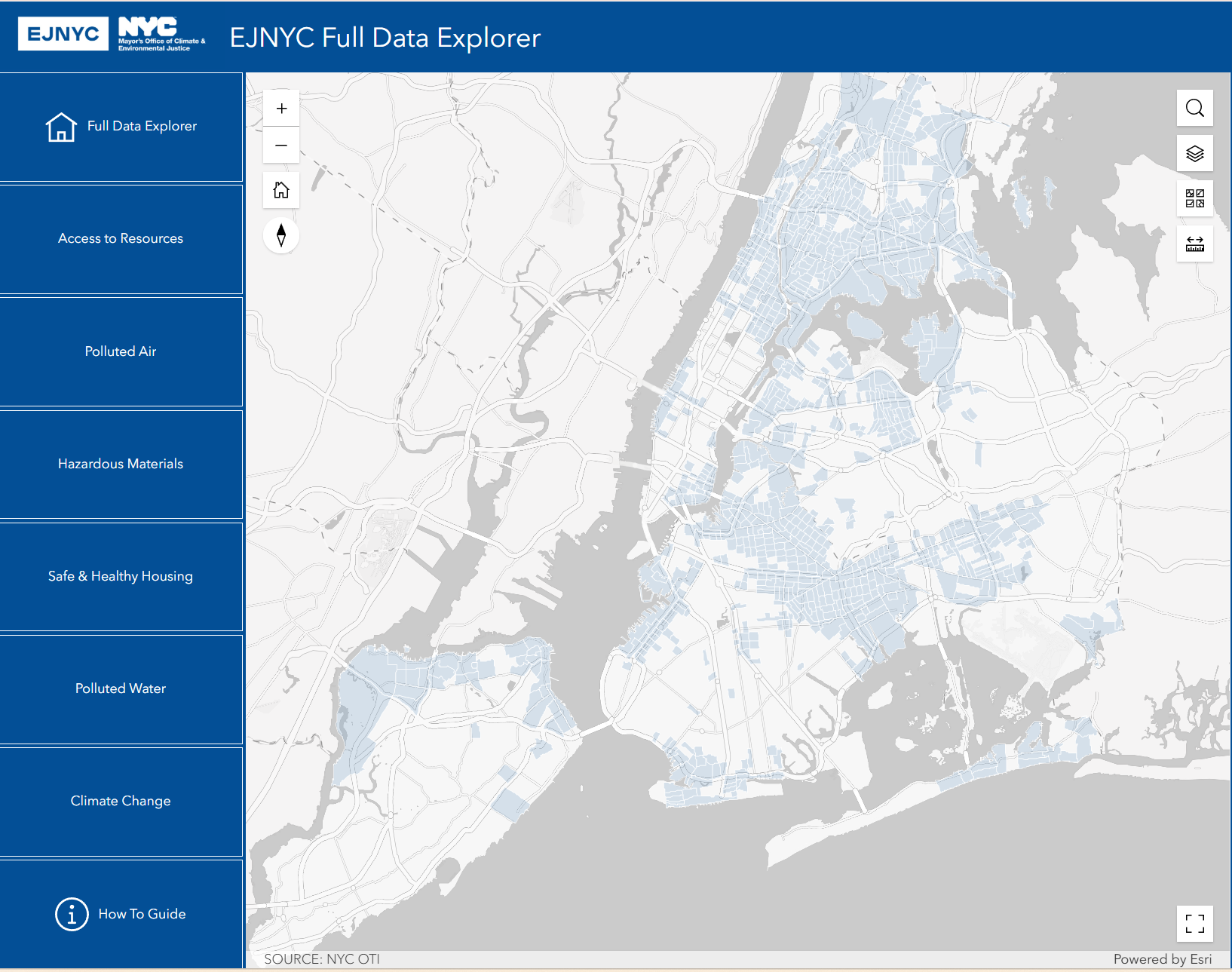
Released in 2024, the EJNYC Mapping Tool is a digital library hosting more than 115 interactive maps relevant to environmental justice concerns or priorities.
In 2017, New York City passed Local Laws 60 and 64 to assess environmental equity issues and develop a plan to incorporate environmental justice into the fabric of City decision-making. This legislation centers on three main products: a report, a mapping tool, and a plan. To carry out this work, the local law mandated that the Mayor and City Council appoint an independent Environmental Justice Advisory Board (EJAB) comprised of nationally recognized EJ advocates and local subject matter experts, and that an Interagency Working Group comprised of staff from 19 city agencies be convened.